

Rhinoplasty Essen, Dr. Tobias Bastian

Surgical Aesthetics · Essen

A nose that breathes.
And belongs to you.

Rhinoplasty in Essen by ENT specialist Dr. Bastian — aesthetic, functional, individual.

As an ENT specialist with advanced training in plastic surgery, I plan form and function in one hand. Rhinoplasty in Essen-Werden.

View procedures Request consultation →

The difference

Those who understand the nose
operate differently.

The nose is not only a profile. It is the central airflow structure of the face: it filters, humidifies and directs every breath. Anyone who operates on it without understanding this function risks breathing problems for an aesthetic result. This happens in plastic surgery more often than most patients realise.

As an ENT specialist with advanced training in plastic surgery, I have worked for years at exactly this intersection: at the septum, turbinates, cartilage and bone. This anatomical depth changes how I guide a scalpel. I plan form against function, never over it.

„Form follows breath. Breath carries the face."

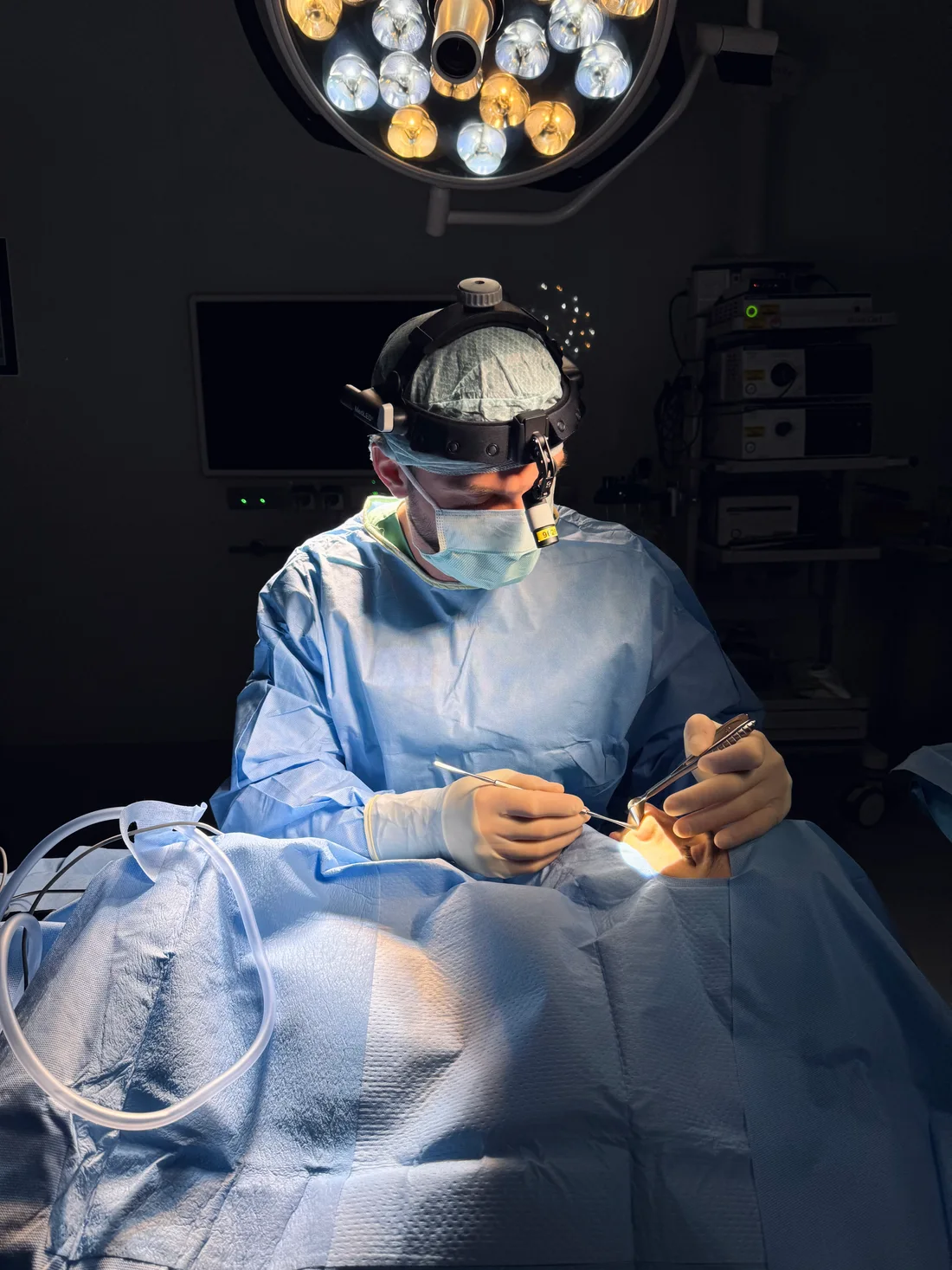
Rhinoplasty procedure – Dr. med. Tobias Bastian, ENT specialist Essen

My Core Expertise

Rhinoplasty,
the nose in balance.

As an ENT specialist I understand the nose in its entirety: breathing function, mucosa, cartilage structure, proportions.

Request consultation →

Indications

Three indications, one surgical standard.

Aesthetic rhinoplasty Essen, Dr. Tobias Bastian

01 · Profile · Tip · Symmetry

Aesthetic Rhinoplasty

A hump, a broad tip, a slight asymmetry: when the profile distracts from the face, aesthetic rhinoplasty is the most precise intervention. My goal is a nose that does not stand at the centre, but belongs to the person.

Learn more


Functional rhinoplasty & septoplasty Essen, Dr. Tobias Bastian

02 · Septum · Turbinates · Airway

Functional Rhinoplasty

A deviated septum, enlarged turbinates, a collapsing nasal valve: functional problems restrict sleep, sport and quality of life. As an ENT specialist, I correct these structures with the same precision as aesthetic parts, often without any visible change from the outside.

Learn more
Secondary rhinoplasty & revision Essen, Dr. Tobias Bastian

03 · Revision · Reconstruction

Secondary Rhinoplasty

When a previous operation has not produced the desired result, functionally or aesthetically, a second operation requires different conditions: scar analysis, cartilage reconstruction, careful management of expectations. One of the focal points of my surgical practice.

Learn more
ENT specialist · Surgical experience · Open & closed technique · Insurance, with indication
Aesthetic rhinoplasty Essen, Dr. Tobias Bastian

01 · Profile · Tip · Symmetry

Aesthetic Rhinoplasty

Form that belongs to the face

Correction of the dorsum, tip, alae or profile line follows no template. Every nose requires its own plan. I work with precise changes to cartilage and bony framework to clarify the profile without standardising personality. The result is a face that does not look operated on.

Treatment areas

  • Nasal hump (reduction or reconstruction)
  • Nasal tip (definition, projection, rotation)
  • Crooked nose (asymmetry correction)
  • Nasal dorsum (straightening, narrowing)
  • Nasal alae (size, shape, symmetry)

Duration

2–3 h

Anaesthesia

General

Inpatient stay

1 night

Billing

GOÄ

Functional rhinoplasty & septoplasty Essen, Dr. Tobias Bastian

02 · Septum · Turbinates · Airway

Functional Rhinoplasty

Breathing that no longer struggles

Functional interventions on the nose are the core field of otolaryngology. Septoplasty, turbinate reduction, valve stabilisation: each step targets free, even nasal breathing. With medical indication, partial cost coverage by statutory or private health insurance is possible.

Treatment areas

  • Septal deviation
  • Turbinate hypertrophy
  • Nasal valve collapse (internal & external)
  • Post-traumatic airway obstruction
  • Chronic sinus involvement

Duration

1–2 h

Anaesthesia

General

Inpatient stay

1 night

Billing

Insurance, pro rata

Secondary rhinoplasty & revision Essen, Dr. Tobias Bastian

03 · Revision · Reconstruction

Secondary Rhinoplasty

Correction after a previous procedure

Revision rhinoplasty is technically far more demanding than a primary procedure. Scar tissue, missing cartilage and altered anatomy require a different surgical strategy. Autologous cartilage from the ear or rib is often used for reconstruction. The consultation begins with a realistic estimate of what is surgically achievable.

Treatment areas

  • Correction of asymmetric previous procedures
  • Reconstruction with autologous cartilage (ear, rib)
  • Repair of functional sequelae
  • Saddle nose, polly-beak deformity, pinched tip
  • Scar management and soft-tissue reconstruction

Duration

3–4 h

Anaesthesia

General

Inpatient stay

1–2 nights

Billing

GOÄ

Modern Techniques

What is possible in
rhinoplasty today.

Each of these techniques pursues the same goal: maximum precision with minimal intervention. The choice always follows your anatomy.

01
Approach

Open or closed

Your anatomy decides – not fashion.

Open Rhinoplasty

Small incision on the columella. Full view of the nasal framework. Indicated for complex corrections, asymmetries and revision procedures. Scar typically inconspicuous.

Closed Rhinoplasty

All incisions inside the nose. No visible scar. Suited to targeted dorsum corrections or selective tip work. Faster healing.

Video coming soon
02
Dorsum

Preservation Rhinoplasty

Dorsal preservation technique

Following the philosophy of Dr. Yves Saban (Nice, France). This technique allows the nose to be operated on significantly more gently and precisely. The natural anatomy of the nose is preserved and modelled rather than removed: a prominent nasal hump can be corrected without leaving palpable edges after surgery. Piezo ultrasound allows a wide nose to be narrowed gently. Via the endonasal approach, the nasal tip can be refined without a visible scar.

Video coming soon
03
Komfort

Surgery without nasal packing

No packing in the nose after surgery.

Today, rhinoplasty is performed without traditional gauze packing. To prevent scar tissue from forming in the nasal mucosa, ultra-thin silicone splints are used instead. These can be removed after 2–3 days at the wound check, without anaesthesia. "Stuffing" the nose with packing and its painful removal is not required.

Video coming soon
04
Precision

Piezo Ultrasound

Bone precise. Soft tissue protected.

Piezo ultrasound enables precise work on the nasal bones without injury to surrounding soft tissue. A wide nose can be narrowed gently – with less swelling and more precise bone work than with classical techniques.

Video coming soon
05
Tip

Nasal Tip Polygon

Structured tip refinement through cartilage analysis.

The nasal tip is the most anatomically complex area in rhinoplasty. The polygon concept describes the geometric analysis of the alar cartilages to precisely influence projection, rotation and definition of the nasal tip – with lasting stability.

Video coming soon

Which technique is right for you is not decided by fashion,
but by your anatomy.

The path to surgery

Four steps. None of them routine.

01

Consultation & analysis

Thorough history, clinical examination, functional diagnostics. We discuss wishes, options and, honestly, the limits.

02

Surgical planning

Digital image analysis, briefing on technique, risks and realistic outcomes. At least two weeks between consultation and surgery for reflection.

03

Procedure

General anaesthesia, 1.5 to 3 hours. Surgery follows your individual plan, open or closed, primary or with septoplasty. Inpatient stay 1 night.

04

Aftercare

Cast removal after 7 to 10 days. Close follow-up appointments over 12 months, until the result is fully healed.

Costs & Billing

How much does rhinoplasty cost in Essen?

The cost of a rhinoplasty depends on the complexity of the procedure, the chosen technique and the inpatient stay. As a private practice, I bill according to the German Fee Schedule for Physicians (GOÄ). A binding cost estimate is provided after the initial consultation — only then do I know your anatomy and correction goal precisely enough.

The cost for an aesthetic rhinoplasty starts from approx. €5,900.

Financing options: Some patients finance aesthetic procedures through specialist providers. Further information is available in the consultation.

All prices are indicative. A binding quote is provided exclusively in the personal consultation. No guarantees — individual results may vary.

Request consultation →

Frequently asked

What patients
often want to know.

Aesthetic rhinoplasty is billed privately under the German fee schedule for physicians (GOÄ). The price varies depending on effort, technique and inpatient stay. Functional corrections such as septoplasty are partially covered by statutory or private health insurance with medical indication. You receive a binding quote in the consultation.

Purely aesthetic correction: no. For functional complaints, such as obstructed nasal breathing caused by a deviated septum, insurers cover the medically necessary portion. In a septorhinoplasty, functional and aesthetic parts are billed separately. Which parts are reimbursable in your case is clarified in the consultation.

The open technique places a small incision on the columella, giving full view of the nasal framework, ideal for complex tip corrections and secondary procedures. The closed technique works exclusively from inside, leaving no visible scar. Both are established procedures. The choice depends on anatomy and surgical goal, not on the surgeon’s preference.

With persistent obstructed nasal breathing, recurrent sinus infections, sleep apnoea involvement or post-traumatic deformities, a functional correction is medically indicated. The diagnostic workup belongs to the ENT field, which is a clear advantage of this practice.

The nasal framework must be fully mature, typically from 17 to 18 years in women and 18 to 19 years in men. A rhinoplasty before growth is complete is not advisable, as the nose continues to change. A personal consultation clarifies the individual situation.

Most patients are socially active again after 10 to 14 days. The nasal cast is removed after 7 to 10 days. Bruising and swelling subside clearly within the first 2 to 3 weeks. Mild residual swelling, hardly visible to others, can last several months. The final result is fully visible after 6 to 12 months.

The goal is always a result that fits the person, harmonious and not looking operated on. The nose should belong to the face, not be its centrepiece. My philosophy: refinement of character, not standardisation toward an ideal.

Like every surgical procedure, rhinoplasty carries risks: bleeding, infection, swelling, in rare cases asymmetries or the need for revision. Thorough planning, modern surgical technique and close aftercare minimise these risks. All risks are discussed in detail during your consultation.

Functional interventions are partially covered by health insurance when medically indicated. Aesthetic portions are billed privately under GOÄ. A binding quote is provided in your personal consultation. No guarantees of cure, individual results may vary.

Opening November 2026 · Essen-Werden

Before surgery,
conversation.

Rhinoplasty is a decision I do not rush. Join the waiting list and secure a consultation appointment for the opening of the practice in Essen-Werden — for patients from the Ruhr region, Düsseldorf, Dortmund and across NRW.

Confidential · No third-party sharing · Privacy Policy